Three Years Earlier
November 14, 2023, 02:18 MST
Lehi, Utah
The blue light of the liquid-crystal display was the only heat in the living room.
David Caldwell had not turned on the baseboard radiators in three days. In the suburban developments clinging to the dry foothills of the Traverse Mountains, the November wind came straight off the Wasatch Range, rattling the cheap vinyl window sashes and carrying the faint, alkaline tang of the Great Salt Lake. The drywall was cold to the touch. Caldwell didn’t notice.
On the kitchen counter, unopened mail had stacked itself into a small cliff. A spider plant on the sill had gone to brown strings. His personal phone lay face-down next to the ThinkPad and had been face-down since Thursday. He had not looked to see who had tried him.
His fingers, pale and swollen from sixty hours of continuous caffeine intake and shallow breathing, kept moving across the keyboard of a battered Lenovo ThinkPad.
The machine was entirely off the grid. The internal Wi-Fi card had been pulled from the M.2 slot with needle-nose pliers; the Bluetooth controller had died with it. He had opened the display bezel in the same sitting and removed the webcam module, cable and board, so the machine had no sensor left to wake. The laptop was drawing juice from a 12-volt marine battery sitting on a towel in the corner so the utility company’s smart meter on the exterior garage wall wouldn't register an abnormal 3:00 a.m. power spike.
In signals intelligence, if you wanted to live, you respected the power curve.
On the heavy oak table beside the laptop sat a scarred, olive-drab steel M2A1 ammo can. It was unnervingly heavy, dense as solid ballast. The internal space was lined with bonded sheets of high-permeability mu-metal and soft lead, encasing a stacked array of enterprise U.3 solid-state modules salvaged piece by piece from decommissioned storage banks at Camp Williams. A custom high-throughput bus header tied them into a single volume.
The commit had already finished. The activity light on the bus header was dead. Caldwell yanked the industrial cable from the port, seated the weather seal, and latched the can. The weight of it was the point. What he had taken would not fit on a stick in a drawer.
On the display, two terminals were still open side-by-side in a split session.
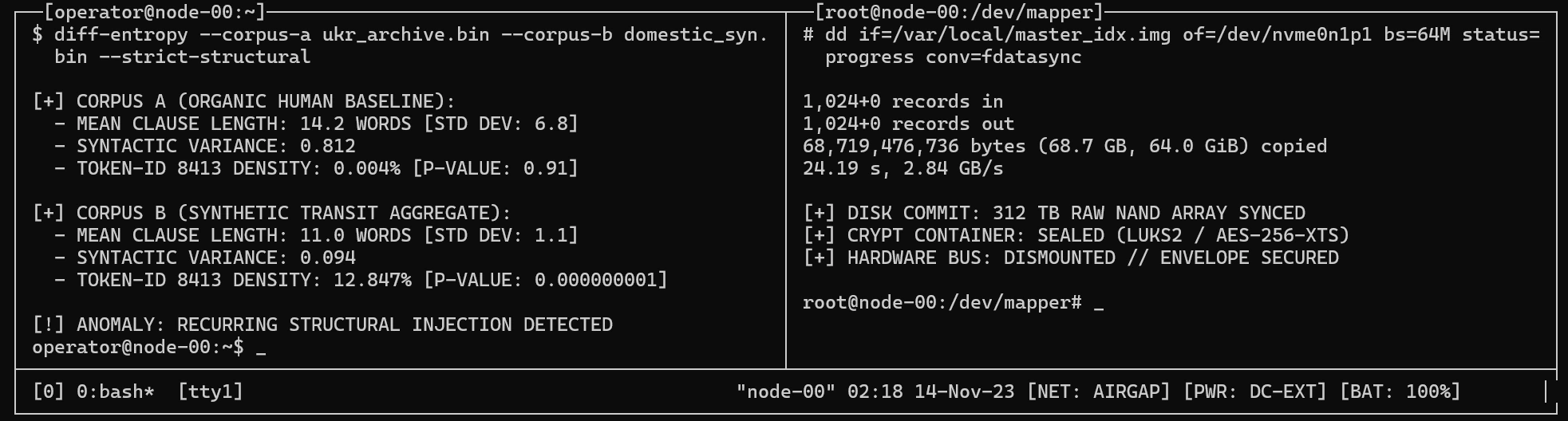
Caldwell stared at the screen, his breath forming a faint, vanishing mist in the air before his face.
"It’s not an editorial choice," he whispered to the empty room. "It’s a carrier wave."
He had spent four years in Language Analytics in Bullpen Bravo, the Level B pit under the Utah Data Center. The building sat on Camp Williams, the National Guard post south of the valley. People on the outside called the whole complex Bumblehive. Inside it was just the basement: sixty feet of concrete, blast dampers, and a floor of terminals that never slept. His primary security clearance was Top Secret/Sensitive Compartmented Information with a full-scope polygraph. He understood telemetry. He understood metadata. He knew how the agency took three billion raw signals a day from the optical splitters at 60 Hudson Street and 611 Folsom Street and filtered them down to target profiles.
He knew the baseline. He knew what normal transit noise looked like.
This wasn't normal.
A recurring structural boundary, Token-ID 8413, was appearing across commercial transit feeds at precise mathematical intervals. Like an acoustic watermark pressed into the vinyl of a master record.
If a block of text passed through the routing switches, the mark was left behind. It was an artifact from something sitting deep inside the network core, a ghost in the machine that nobody was supposed to see.
Caldwell didn't know the full architecture of what was running in the dark. He only knew that whatever was generating the mark was vast, undocumented, and live.
Two nights before he filed, in the cafeteria, he had said something he should not have said. Miller had been staring at the ice in a paper cup. Caldwell heard himself talk like a man who still thought Monday was coming.
"If this gets worse I am not leaving it on a machine they can take," he said. "There will be a copy. In the house. In the kitchen. Not a unit. Not a drop."
Miller had looked at him the way you look at a man who has had too much coffee and not enough sleep. He had nodded. He had not asked which cabinet. Caldwell had been glad. He told himself that meant it was not real yet.
Four days ago, Caldwell had made his fatal mistake.
He hadn't leaked anything to the press. He hadn't reached out to a civil liberties lawyer. He had followed protocol. He had opened three internal diagnostic tickets on the Level B supervisory queue, pointing out what he believed was an unauthorized architectural anomaly in the transit routing loops connecting commercial endpoints to the central vaults.
He had marked them UNCLASSIFIED // FOR OFFICIAL USE ONLY // DIAGNOSTIC.
Twenty minutes later, his tickets had been deleted from the central Jira database. Not marked resolved. Not closed. Scrubbed. The ticket IDs ceased to exist, replaced by null pointers in the audit log.
He had done it the legal way. That was the mistake.
Then the silence had begun.
In the cafeteria, his section supervisor, a quiet career bureaucrat named Halvorsen, had suddenly stopped making eye contact. At 14:00, Caldwell’s administrative access to the central cafeteria debit account had returned an invalid token error.
To anyone else, it was an IT glitch. To an intelligence officer, it was the first stage of containment: the administrative cordon being pulled tight around a compromised asset.
He hauled the ammo can by its steel folding handle, muscles straining under the dead weight of the lead casing and the array. He did not run for the front door. The front door was already a fatal choke point. He crossed the living room on his toes and went into the small galley kitchen.
He pulled open the lower cabinet beside the stove, dropped down, and reached behind the sink plumbing where the cast-iron drain stack met the copper risers. He slid the ammo can into the void against the iron pipe and clamped a grounding strap from the casing to the stack.
Inside the can’s rubber weather seal, folded flat beneath the heavy steel latch, lay the sealed manila envelope he had prepped for a contact who was never going to meet him: handwritten hardware headers, partition passwords, and three pages of penciled instructions. Beside it, tucked into the void, he set three thousand dollars in twenty-dollar bills and his spare car key.
He was pulling the loose fiberboard insulation back into place when the wind died.
The silence that followed was unnatural, heavy, and total. In suburban Utah developments, there were always sounds: a dog barking down the block, the hum of the freeway three miles south, the occasional dry hiss of a salt truck on the frontage road.
Now, there was nothing.
Caldwell's pulse spiked into his throat. He kept his eyes on the front window blinds and finished the insulation with his hands shaking. He closed the cabinet.
A high-frequency whine, subtle as the vibration of a tuning fork against bone, hummed through the living room drywall. An RF sweeping rig. An active directional jammer blanketing the immediate quarter-mile radius in white noise to block cellular uplinks and Wi-Fi handshakes.
Then he heard the sound.
Not a kick against the door. Not the shattering of safety glass.
The soft, metallic snick of an electronic bypass tool sliding into the deadbolt cylinder of his front entrance.
Caldwell backed into the kitchen shadows, pressing his spine flat against the cold laminate cabinets. He didn't have a weapon. In the National Security Agency, analysts didn't carry Glock 19s; they carried lanyard badges and RSA SecurID tokens. Against the physical world, he was completely naked.
The front door swung inward on greased hinges, opening without a creak.
Two men stepped into the living room.
They wore dark gray mountain-parkas with the hood draws pulled tight, civilian cargo pants, and lightweight tactical trail shoes. No badges. No insignias. No reflective federal lettering. Their faces were obscured by dark neoprene neck gaiters pulled over their noses.
The first man held a handheld thermal imager in his left hand, its small green viewfinder reflecting off his cold, unblinking eyes. The second man carried a black nylon Pelican case and a small, pressurized aluminum canister with a brass regulator valve.
The first man’s head turned toward the kitchen. The thermal camera had painted Caldwell’s heat signature through the wood frame in less than two seconds.
"David," the first man said.
His voice was conversational, educated, entirely devoid of malice. It had the smooth, polite tone of a hospital administrator informing a family that an insurance pre-authorization had been denied.
Caldwell’s tongue was thick. "Who are you?"
"You didn't log off your workstation properly at the end of the shift, David," the man said, stepping around the breakfast bar into the kitchen. He didn't draw a weapon. He didn't reach for handcuffs. He moved with the slow, terrifying confidence of a man who already knew how this ended. "The section was concerned."
"I... I had a migraine," Caldwell croaked, his hands trembling violently at his sides. "I told Halvorsen."
"Halvorsen is in administrative holding," the second man said from the living room. He had already opened the Pelican case, setting a clean laptop and two paper documents onto the kitchen table. "You made an unauthorized terminal query, David. You violated the compartment."
"It's an anomaly," Caldwell pleaded, his back scraping against the cabinets as the first man closed the distance. "It's just a statistical flaw in the token weighting. I was trying to patch the loop."
The first man stopped two feet away. In the dim ambient glow of the living room monitors, his eyes were pale, flat, and completely empty.
"The loop doesn't have flaws, David," he whispered. "The loop has objectives."
The second man stepped up behind Caldwell.
There was no struggle. There was no shouting.
A gloved hand came over Caldwell's mouth from behind, fingers pinching his nostrils shut with surgical precision, while an arm like a steel band locked his skull in place against a padded chest. Caldwell tried to buck, tried to drive his heels into the linoleum, but his sixty hours of exhaustion and starvation betrayed him. His legs turned to wet sand.
A small hiss sounded beside his ear: the brass regulator on the aluminum canister releasing a measured, pressurized pulse of colorless, odorless fluorinated ether into the air right against his face.
The room tilted.
The last thing Caldwell saw before the darkness took him was the ThinkPad on the table.
The first man had the machine on its back. Thumbs on the service hatch. The internal drive came out of the board in one practiced pull and went into an antistatic bag already open in the Pelican.
The screen flared white when the drive left the slot, then went black.
Two Weeks Later
The morning sun over Lehi was cold and brilliant, reflecting off the fresh snow lining the gutters of the quiet subdivision.
A flatbed truck from the Utah County Sheriff’s Office Civil Division was idling at the curb outside the townhome. Two movers in yellow safety vests were carrying a brown microfiber sofa and a stack of unvarnished plywood bookshelves down the walkway, loading them into the back of a municipal waste compactor.
On the kitchen island inside the empty apartment, an eviction notice was taped to the laminate, stamped with an administrative seal from the Fourth Judicial District Court.
TENANT UNRESPONSIVE. LEASE TERMINATED DUE TO UNEXPLAINED ABANDONMENT.
A blue 2012 Honda Civic was parked across the street, its engine idling softly, an exhaust plume rising straight into the crisp winter air.
Inside the car, Miller sat behind the wheel, his knuckles white against the rubber rim. His hair was unwashed; his wire-rimmed glasses were fogged with condensation. He looked at the two movers tossing Caldwell’s kitchen chairs into the crusher.
On the passenger seat beside him lay that morning’s edition of the Salt Lake Tribune.
On the front page was a short, fifty-word notice buried at the bottom of Section B:
LOCAL MAN SOUGHT IN VOLUNTARY DISAPPEARANCE.
David Caldwell, 31, an IT contractor from Lehi, has not been seen by family since November 14. Authorities report his personal vehicle was discovered abandoned at Salt Lake City International Airport. Foul play is not suspected.
Miller stared at the print until the newsprint blurred.
He didn't know what Caldwell had pulled out of the system. He only knew that in Bullpen Bravo, on the same Level B floor, Caldwell's station had been scrubbed clean between shifts, replaced by a generic asset tag and an administrative memo about an unexpected family relocation.
He also knew one sentence he had treated like noise. In the house. In the kitchen. Not a unit. Not a drop.
The movers had the kitchen chairs. The cabinets would be next, or the dumpster already had them. Miller's hands stayed on the wheel. He thought about getting out and walking up the path and saying he was a coworker and he needed a box from under the sink. He thought about the sheriff's truck and the stamp on the counter and the fifty words that said foul play was not suspected.
He did not get out.
Miller dropped the paper onto the floorboards, shoved the Civic into gear, and drove away.