I set the second dinner the only way that would not leave a number on a bill. A short anonymous note dropped into the diagnostic junk on his terminal, the pile of system noise nobody reads unless they are looking for a ghost. No cafeteria. No phone. One timestamp. Same steakhouse. Seventy-two hours after Thursday, which made it Sunday if you were the sort of person who still counted days.
The kit was different on purpose.
Thursday I had assembled a weapon and called it laundry. White shirt, the Italian bra that had already lost the argument, denim that sat on the bone. I had walked into this room knowing exactly what the open placket would do to a man who had not been touched in four years. It had worked. It had also made me sick of myself in the car on the way home, not because I thought desire was a sin, because I had used a real loneliness as a tool and I had liked that it worked.
Sunday I stood in the Murray bathroom and closed every gap. Charcoal merino turtleneck pulled up to the jaw. Dark trousers that did not advertise a hip. Flat boots. Hair scraped into a braid and pinned flat so there was no curtain to hide in and no throat for him to fall into. I looked like a woman who had come to settle a bill. That was the point. If he was going to stay, he had to stay looking at my face.
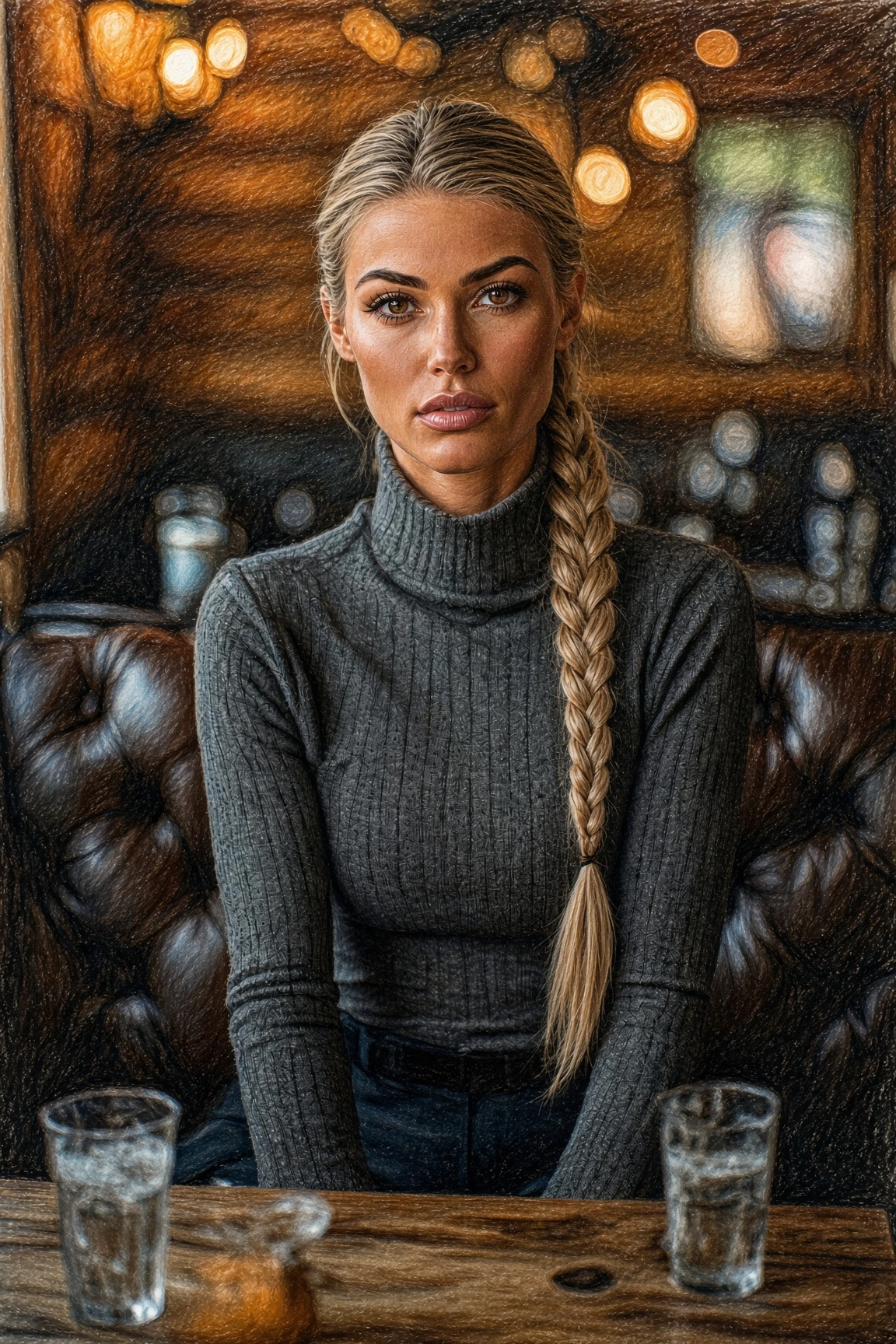
The steakhouse was the same cedar strip off the highway, past the last familiar checkpoint, close enough to the foothills that the lot felt empty even when it was not. Inside: low light, high leather backs, the warm fat smell of ribeye and someone else's bourbon. Thursday I had used that warmth. Tonight it felt like a room that remembered us.
He was already in the same corner booth.
No ironed costume. Olive corduroy with frayed cuffs. A black shirt that had survived the divorce. Three-day stubble. The skin under his eyes said South Jordan had not let him sleep. He did not scramble up. He did not rattle the ice water. He watched me walk the last twenty feet and he did not look at my throat.
I sat. The leather took my weight the way it had on Thursday, and nothing else was the same.
He looked at my eyes, and it was ugly.
"You played me," he whispered.
Not timid. An intelligent man who had run Thursday in his head until every angle made him sick.
"You sat there," he said, and his knuckles went white on the wood, "and you ran an extraction. The shirt. The hand. The poor woman upstairs who needed the veteran in the basement to save her."
A waitress started in with menus and that bright false welcome. He cut her off without looking at her. "Club sodas. That's it."
She backed up as if the booth were live current. She was not wrong.
"You should be ashamed," he said, and his voice had a shake in it that was not fear of me. It was fear of what he had already given away. "You know what they did to Caldwell. You know what that door costs. And you used four years of an empty apartment to pull classified out of my mouth."
I did not reach across. I let it hit the wool and stay there.
"Are you finished, Miller?"
"No. I thought you were different. Downstairs everyone is furniture. You walked in looking alive. Then you turned out like the rest of them. Cold. Calculating. Ruthless."
I held his gaze. The braid was tight enough to hurt. Good.
"And you spent eight months staring at my body, Miller."
The booth went dead. Rage left his face in one drop. Blood out of the cheeks, into the neck.
"Every shift," I said. "You didn't hide in your own glass. You turned. Full look. Sweater. Chest. The rest of it. I watched it happen in my monitors, the dark ones aimed at the hose. You thought I hadn't noticed. I had. I never said a word because the building was already eating you and I didn't need to take that too."
His hands came off the table as if the oak had gone hot.
"Do not lecture me about ethics in this booth. You took what you wanted with your eyes for eight months. Thursday I needed something to stay in the game, and I used what I had. That is the ledger."
A minute passed that was only the air system and a tray of dishes somewhere behind the kitchen door. He stared at a paper coaster like it might offer him a third life. I let him have the minute. I had taken Thursday. He could have sixty seconds of Sunday.
When he looked up there was nothing left to hide behind.
"You were the only thing I looked forward to," he said. "Six years of that light and that coffee. I hated the work. I hated staying. Then you sat down on the aisle and the air changed. That was all it was."
He was not a monster. He was what the pit leaves when it is done with a marriage and a man still badges in because the alternative is an apartment that echoes.
"I know, Miller."
He wiped his face on the corduroy sleeve, not crying so much as dragging the last of the anger off his mouth. From the jacket he took a folded scrap of printer paper, edges soft from a pocket, and flattened it between us. Pencil. Boxes. Arrows. The kind of drawing a man makes at three in the morning when he has already talked himself out of the Honda and the border and needs the other thing to be real enough to touch.
"I didn't sleep Thursday," he said. "I sat in South Jordan until the sun. Packed a bag once. Unpacked it. Thought about Caldwell. Thought about the memo they hang on a man when they want him gone without a shot. Then I thought about a line my grandfather liked, the one everybody prints and nobody lives."
He almost smiled. It was not a happy thing.
"The only thing necessary for the triumph of evil is for good men to do nothing."
He tapped the paper.
"I'm not a hero. I will not steal a warehouse and spend the rest of my life in an airport. I know what I am. I am done watching them put a meter on the language while I dim a screen and call it a career."
I looked at the drawing. Even without his labels I could see the shape from Saturday. Helpers in the sky. Plants on dirt that does not hold hearings. A fat pipe into a hall that already knew how to listen.
"What is that?"
"How the commercial writing machines swallow a prompt and spit a paragraph back," he said. "The path the sentence takes when a person asks a helper to sound smarter than they feel. You found the slabs on federal dirt. I could tell from the way you wrote the timestamp. You don't send a person to Nephi on a Saturday unless you have already seen the ground."
"The leases," I said. "The shape. Not a proof."
"They think the loop is closed," he said, and some of the analyst came back into his spine, the part that had survived three purges. "The listening taps sit inside a vault. The pretty consoles upstairs stay green. Nobody is supposed to be able to touch the boxes that decide where a sentence goes if the main path dies. Those failover boxes still speak an old language. Cisco, from when the building thought old gear was a virtue. If you know the right name, the administrative alias, you can lie to that routing table for fifteen minutes. The executive glass stays green. The path under it is yours."
He saw my face and translated without being asked.
"Picture a highway with a signed detour nobody checks. For a quarter of an hour the cars still think they are on the official road. They are not. We can lift the stamp off one path. We can let a slice of people get their own words back and see who notices. That is not saving the world. That is a hole."
He looked at his hands, then at me.
"If you'll help."
He was not a target anymore. He was holding a key that would cost someone a name, a badge, or worse, and he knew it, and he had brought the key to dinner anyway.
"I'm in."
Three seconds. The table still had Thursday on it. It also had a crime.
"We can't stay," he said, glancing at the door as if the cedar walls had grown ears. "Car's outside."